
Cloud-First Strategy: Essential to Building AI-Ready Infrastructure

What Got Us Here Won’t Get Us There 

In one sense, cloud used to be a back-end decision. A decision about uptime, hosting, and cost savings. In another sense, cloud is a transformational enabler supporting global scale, super-fast time-to-market or agile business. 

But we’re no longer just migrating and modernizing workloads. We’re designing AI scale. 

In this new world, infrastructure decisions are no longer operational. They’re strategic. And if your foundation isn’t built with AI in mind, you’re engineering future technical debt instead of innovation. 

Why Cloud-First Now Means AI-First 

Let’s get one thing straight: adopting the cloud is no longer just about digital transformation. It’s about survival in an AI-driven economy. 

We’re not just talking about server consolidation or uptime guarantees. We’re talking about building a foundation that supports real-time intelligence, generative workflows, and continuous decision-making at scale. 

AI is no longer a feature. It’s an operating model. 

From finance to government, healthcare to logistics, AI is being carefully embedded deep into the core of service delivery. But here’s the kicker: most legacy cloud stacks were never designed to support what AI needs today, let alone what it will need tomorrow. 

What is missing? 

  • Architecture for real-time inferencing. 
  • Elastic compute at scale for training or fine-tuning models in production. 
  • Data fusion capacity to combine structured data, unstructured data, IoT streams, and more. 

The traditional cost-effective cloud migration playbook — lift, shift (and forget) — is no longer enough. 

Strategic Checkpoint 
If your current infrastructure can’t support real-time decisioning, data orchestration, or model retraining on the fly, it’s not AI-ready. It’s already legacy. 

That’s why cloud-first today must mean AI-first by design. 

Your architecture choices — compute, storage, integration protocols — must anticipate the evolving demands of machine learning and inference, not just the needs of standard enterprise workloads. 

The question isn’t: “Is our cloud scalable?” 

The real question is: “Is our cloud stack smart enough, fast enough, and secure enough to power our future AI-enabled industry?” 

And if you’re not asking that yet, your competitors probably are. 

The Capabilities of an AI-Ready Cloud 

This isn’t the future. It’s the new minimum. 

To design cloud infrastructure that’s truly AI-ready, leaders must move beyond the checklist of generic cloud benefits. The capabilities below are not “nice to haves”. They are the architectural essentials needed to power intelligence at scale. 

Let’s break it down: 

Inference and Training Compute at Scale 

AI workloads don’t run on standard computers. They demand accelerated infrastructure: GPUs, TPUs, auto-scaling clusters, the kind that can expand instantly to support large language models or deploy AI features across multiple business units. 
If your AI compute stack can’t scale elastically in minutes, you’re not ready to iterate fast enough. 

Low-Latency Data Access 

AI-first clouds are designed with data proximity and edge access in mind—delivering compute on data in milliseconds, not minutes. 

Data Lakehouse Architecture 

AI eats data. Structured and unstructured. But siloed systems create friction. That’s why AI-first clouds adopt a lake house architecture: the flexibility of a data lake with the governance of a warehouse. 
This allows everything — systems of record, call transcripts, sensor streams — to train and fuel intelligent apps in one ecosystem. 

MLOps Tooling 

You don’t just deploy AI. You monitor, retrain, and version it. 
That’s where MLOps pipelines, model registries, version control, and drift detection come in. The best AI clouds bake these into the core, so teams can iterate responsibly and ship faster. 

Zero Trust Security 

With AI accessing sensitive data, security must evolve to integate Zero Trust by design. That means identity-first access, always-on encryption, threat detection, and governance frameworks (like ISO/IEC 27001) enforced at every layer in your AI platform. 

Bottom line? 
If even one of these elements is missing, your cloud is likely optimized for yesterday’s workloads and not the intelligent systems of today and tomorrow. 

The Risk of Legacy Thinking 

Let’s make this clear: just moving workloads to a traditional cloud landing zone doesn’t mean you’re AI-ready. 

The legacy approach— “lift and shift”—might tick the box for a cost-effective cloud migration, but it rarely delivers the agility or intelligence needed for modern, data-driven organizations. In fact, it often creates more problems than it solves. 

Here’s where it falls apart: 

1. Infrastructure Bottlenecks Stall AI Initiatives 

AI workloads are dynamic. They spike, shift, and scale. Without burstable compute, accelerated processing, and orchestration-ready storage, your AI pilots will crawl. 
What looks like a “failing” AI use case is often just an underpowered backend that can’t keep up with model demands. Leaders mistake the symptoms for the root cause. 

2. Agile Business Processes Are Missing In Action 

Agile business processes are critical for AI-enabled cloud applications because they provide the flexibility and responsiveness needed to adapt to rapidly evolving technologies and market demands. AI-driven systems thrive on continuous learning and iterative improvement. By embracing agility, organizations can pivot and quickly integrate new AI capabilities.  

3. Data Silos Break AI Orchestration 

AI isn’t magic. It needs unified, high-quality data to deliver insights. But legacy environments often replicate existing silos, spreading core systems like EHRs in one corner, billing in another, and patient communications in a third. 
Without semantic interoperability and data lake house unification, your AI models can’t learn from the full picture. 
Result? Biased outputs, limited automation, failure to scale. 

4. AI Governance is not Robust Enough To Protect You

AI governance must address dynamic, autonomous decision-making on top of static cloud infrastructure controls. While traditional cloud governance focuses on compliance, cost management, and resource allocation, AI governance introduces the need for ethical oversight, bias mitigation, and transparency in algorithmic outcomes. Without robust AI governance, organizations risk deploying systems that make opaque or harmful decisions at scale. This shift demands frameworks that go beyond technical controls to ensure accountability, fairness, and trust in AI-driven cloud operations. 

Strategic Checkpoint for Digital Leaders 

Before the next round of AI pilots or cloud investments, pause. The decisions you make now will either accelerate your transformation, or cement future bottlenecks. 

Ask yourself (and your team): 

Can our infrastructure architecture, business processes and governance support real-time AI inference at scale? 

This isn’t just about computing horsepower. It’s about: 

  • Latency thresholds that enable immediate decision-making. 
  • Edge/cloud coordination for AI use cases requiring speed at the point of care or interaction. 
  • Auto-scaling AI clusters that adjust dynamically with demand. 
  • Governance of the use of AI systems. 

If your models lag in production, it’s not your AI, it’s your foundation. 

Are we locked into a provider ecosystem or future-ready through open standards? 

Open architectures aren’t a luxury. They’re insurance against stagnation. Look at: 

  • API flexibility to connect emerging tools, not just legacy ones. 
  • Vendor-agnostic orchestration so you can deploy AI models across clouds and geography. 

Being locked-in means being locked out of agility. 

Is our security model baked-in or bolted on? 

Cyber risk is no longer a compliance issue—it’s a strategic vulnerability. 
You need: 

  • Zero Trust principles at every level—identity, device, workload. 
  • End-to-end encryption for data at rest, in transit, and in use. 
  • AI-aware threat detection that learns and adapts in real time. 

Retrofitting security is a sign your stack wasn’t designed for AI, and that’s a risk. 

Are we investing in future-proof architecture—or just shifting today’s tech debt to tomorrow? 

Modernization doesn’t mean taking your old systems and giving them a new address in the cloud. 

Ask: 

  • Are we adopting modular, composable architectures that can evolve? 
  • Are we tracking technical debt alongside our roadmap? 
  • Do our platforms support continuous delivery, not just periodic upgrades? 

Because AI is moving fast, and outdated infrastructure will always be your slowest team member. 

Final Thought 

AI is no longer a future ambition. It’s a present requirement. But success won’t come from plugging AI into yesterday’s infrastructure. 

It will come from leaders bold enough to rethink their cloud stack. Not just as a utility, but as an AI accelerator. One that’s elastic by default, secure by design, and intelligent at its core. 

Because in today’s race for innovation, speed alone won’t win. 

The winners will be those who build cloud foundations smart enough to fuel tomorrow’s intelligence today. 

Let’s build for the next decade, not the last one. Let’s build with AI in mind. Let’s build it wisely. 

Resources 

Cloud in Healthcare: How Australia is Using AI to Transform Digital Health 

What if your next medical breakthrough isn’t a new drug or device— 
but the cloud infrastructure running quietly behind the scenes? 

Australia’s healthcare system is undergoing a quiet revolution. And at the heart of it isn’t just AI, or machine learning, or cutting-edge telehealth tools—it’s the rapid evolution and reach of cloud computing. 

From telemedicine in remote towns to real-time hospital analytics in the CBD, cloud infrastructure is no longer an IT decision. It’s a care decision. And it’s accelerating faster than most organisations are ready for. 

The Rise of Cloud in Australian Healthcare 

Cloud computing in Australian healthcare has gone from experiment to essential. 

In 2022–23, 20% of all GP services were delivered via telehealth—phone and video are now a standard part of care delivery, particularly in rural and aged care settings. 

Electronic Health Records (EHRs) are evolving from static repositories to dynamic, AI-ready platforms. 

Predictive analytics is helping hospitals forecast admissions, manage resources, and reduce waiting lists. 

But with every new capability comes a challenge: integration, security, governance, and compliance. 

Cloud has shifted from a back-end technology to a strategic engine for growth and innovation. It’s becoming the backbone of modern health delivery—and the risk and compliance surface has expanded accordingly. 

AI in Action: Smarter, Faster, Fairer Care 

Australia is at the forefront of AI and ML innovations in healthcare. 

  • AI triage bots are helping assess symptoms and direct patients to appropriate care pathways. 
  • Machine learning models are predicting patient deterioration in emergency rooms. 
  • Natural language processing is accelerating clinical documentation, giving practitioners more time with patients. 
  • Computer vision is assisting radiologists in detecting anomalies more quickly and accurately. 

These use cases are not hypothetical. They are operational today—and they rely on scalable, secure cloud environments. 

However, these technologies are only as strong as the infrastructure they run on. And in healthcare, that infrastructure must meet an exceptionally high bar. 

The Privacy and Compliance Tightrope 

Healthcare cloud adoption in Australia must navigate a complex environment of privacy laws, ethical obligations, and system-wide compliance expectations. 

Technology teams supporting healthcare are not simply managing digital records—they are stewards of public trust. 

The Privacy Act 1988  and the My Health Records Act 2012  impose clear responsibilities around data sovereignty, consent, and transparency. 

The Australian Digital Health Agency maintains national standards for interoperability, access controls, and cybersecurity. 

Accreditation frameworks such as ISO/IEC 27001  and IRAP (Information Security Registered Assessors Program) are becoming mandatory in procurement processes. 

Choosing the wrong cloud partner is not just a technical oversight. It becomes a compliance issue, a reputational risk, and an ethical liability. 

Choosing the Right Cloud Partner for Healthcare in Australia 

For healthcare leaders, selecting a cloud partner in healthcare is no longer a purely operational decision—it is a strategic one. 

At a minimum, ensure your cloud solution offers: 

  • Data residency within Australia 
  • IRAP-assessed infrastructure 
  • Proven interoperability with national digital health systems 
  • Capacity to support AI and machine learning workloads 
  • Transparent security protocols, SLAs, and audit trails 

Above all, choose a partner who understands that in this sector, the goal is not disruption. The goal is safe, sustainable, patient-focused innovation. 

Final Thought 

If you’re leading technology in a healthcare organisation, the question is no longer whether cloud and AI should be adopted. 

The real question is: are we building the kind of infrastructure that can support the next decade of health innovation? 

Because in the end, this is not just about platforms and data. It is about empowering clinicians. It is about faster, more informed decisions. And ultimately, it is about improving lives—quietly, securely, and intelligently in the background. 

Let’s build that future—thoughtfully, together. 

Resources 

1. MBS Telehealth Post-Implementation Review Final Report 
https://www.health.gov.au/sites/default/files/2024-06/mbs-review-advisory-committee-telehealth-post-implementation-review-final-report.pdf 

2. Patient Experiences in Australia 
https://www.abs.gov.au/statistics/health/health-services/patient-experiences/latest-release 

3. Australia Telehealth Market Report 2025–2034 
https://www.expertmarketresearch.com.au/reports/australia-telehealth-market 

4. Privacy Act 1988 
https://www.oaic.gov.au/privacy/privacy-legislation/privacy-act-1988 

5. My Health Records Act 2012 
https://www.legislation.gov.au/Details/C2012A00184 

6. IRAP – Information Security Registered Assessors Program 
https://www.cyber.gov.au/acsc/view-all-content/programs/irap 

7. ISO/IEC 27001 – Information Security Management 
https://www.iso.org/isoiec-27001-information-security.html 

8. FHIR (Fast Healthcare Interoperability Resources) 
https://www.hl7.org/fhir/ 

9. Real-Time AI for Patient Deterioration Prediction

Source: National Library of Medicine (PubMed)

https://pubmed.ncbi.nlm.nih.gov/37150397/

10. AI Chatbots in Australian Healthcare

Source: University of Melbourne, Pursuit
https://pursuit.unimelb.edu.au/articles/the-promise-and-peril-of-ai-chatbots-in-healthcare

11. Computer Vision in Radiology (SA Medical Imaging)

Source: Adelaide Now (News Corp Australia)
https://www.adelaidenow.com.au/news/south-australia/artificial-intelligence-advising-on-xray-diagnoses-in-sa-medical-imaging/news-story/ae20cc4c30320354069d586ca1d23846

Hybrid and Multi-Cloud Strategies in Australia

Hybrid and multi-cloud strategies are becoming table stakes for forward-looking organisations in Australia — and for good reason. Across industries, cloud strategies have been put in place to support business objectives. As cloud adoption deepens, leaders are looking for smarter, more resilient IT.

Cloud platforms offer scale, global reach, smarter cost control, and resilience when things go wrong.

Relying on just one cloud provider can affect your cyber resilience and service availability

Digital change is moving fast, compliance demands are getting tougher, and market conditions are shifting constantly. Leaders need IT that bends, not breaks.

Hybrid and multi-cloud aren’t simply tech buzzwords. They’re the way Australian organisations stay in control, meet compliance, and build resilience.

What is Hybrid Cloud? What is Multi-Cloud?

Hybrid cloud

Hybrid cloud blends private IT infrastructure with public cloud services. Sensitive or regulated data stays under your control in a private environment, while public cloud gives you the flexibility to scale when demand spikes.

Think of it as keeping your most valuable assets in a safe at home, while renting extra storage space when you need room for the less sensitive stuff. It’s about balancing control with flexibility, using the right environment for the right job.

Multi-cloud

Multi-cloud takes it a step further. Instead of committing everything to one provider, businesses spread workloads across platforms like AWS, Azure, or Google Cloud. This avoids lock-in, reduces risk, and gives organisations the freedom to use the best tool for each task.

It’s a bit like diversifying your investments. You wouldn’t put your entire portfolio into one stock. Multi-cloud works the same way — spreading risk, increasing resilience, and giving you more leverage when the market shifts.

Why Australian Businesses Are Going Hybrid and Multi-Cloud

Choosing the Best Services

No single provider does everything perfectly. Amazon Web Services are well-known for innovative solutions and cutting edge services. Microsoft 365, Dynamics 365, Power Platform and Azure provides an established ecosystem of building blocks that interoperate almost seamlessly.

Cloud management tools have been improving. Now there are solid, dependable tools for managing your hybrid cloud / multi-cloud platforms. Azure Arc is gaining a lot of traction.

Compliance and sovereignty.

Many organisations keep sensitive data secure in their own infrastructure while using a public cloud for extra capacity.

This is carefully considered in Australia with many high-profile data privacy breaches reported lately. Regulations demand that patient records, financial data, and other sensitive information remain onshore under strict control — a clear case of data sovereignty shaping how organisations use the cloud.

Hybrid cloud makes compliance more straightforward than relying on public cloud infrastructure: keep the sensitive data local, let other workloads benefit from global scalability. Compliance, tick. Agility maintained.

Resilience and Return on Investment.

By blending in-house systems with cloud platforms, organisations create stronger safety nets.

The payoff is real. Industry reports, including the 2023 Intel analysis, show that enterprises applying disciplined FinOps practices — cost visibility, optimisation, and governance — have improved cloud ROI by as much as 30% in a single year. These results highlight the tangible business benefits of hybrid and multi-cloud strategies when paired with strong financial operations.

But pause for a moment — what would just one hour of downtime cost your business in sales, trust, and reputation?

Reducing Risk with Hybrid and Multi-Cloud

Escaping vendor lock-in.

One of the biggest risks of going all-in with one provider is getting stuck. If costs rise or service dips, you’ve got little choice.

Multi-cloud changes that. By spreading workloads, businesses gain leverage, independence, and flexibility. Ask yourself: what’s your plan if your only provider suddenly changes the rules?

Stronger disaster recovery.

Resilience isn’t a buzzword. It’s survival. Hybrid cloud setups let critical systems mirror each other between private and public environments — if one fails, the other steps in.

Multi-cloud goes further, shifting workloads across providers and regions. For banks, healthcare, and retail — where every minute counts — this isn’t optional. It’s a business imperative.

Practical Advice for Building a Hybrid Strategy

Moving to hybrid or multi-cloud isn’t just about adding a second provider. It’s about designing smarter. Start here:

  • Map workloads. Keep regulated data close to home. Run seasonal or high-volume apps in the public cloud.
  • Stay cloud-agnostic. Use tools like Kubernetes or Terraform to stay portable.
  • Build in security. Encrypt data, apply Zero Trust, check compliance often.
  • Simplify operations. Unified dashboards and automation prevent complexity from spiralling.
  • Track costs. Apply FinOps to right-size resources and monitor usage continuously.
  • Invest in people. Upskill IT teams or bring in experienced partners. The best plan fails without the right people behind it.

Think of it like building a winning sports team. Technology is the stadium, but it’s people who win the game.

Why Now Is the Time?

Hybrid and multi-cloud aren’t passing fads. They’re the new building blocks for businesses that want to stay competitive, compliant, and resilient. This shift reflects a wider digital transformation across Australia, where cloud-first has become the norm.

The bottom line: organisations that adopt hybrid strategies today will be better prepared for tomorrow — whether that’s scaling fast, meeting new compliance rules, or surviving an unexpected outage.

So here’s the question: will your IT bend when the pressure comes, or will it break? For organisations exploring hybrid cloud Australia and multi-cloud Australia solutions, the time to act is now.

Hybrid and multi-cloud are your multi-pronged digital foundation — flexible, reliable, and ready for whatever comes next.

What’s Next for Your Cloud Strategy?

If your business is still tied to a single provider, now is the time to rethink. Start small, map your workloads, and explore what hybrid and multi-cloud could unlock for you.The question isn’t if you’ll need it. The question is how soon you can get it right.

Resources

SaaS and AI: The Future of Cloud Computing 2025

I found this draft I wrote this at the end of 2024 and had planned to publish, however time and events conspired against me. I think this is still valid and somewhat insightful – just bear in mind it was six months ago…

Thank you 2024, that’s a wrap! Over the year we’ve seen the switch from AI experimentation to development of some real use cases. A lot of development to incorporate AI into products. No doubt there will be more of this next year. For now the highlights of 2024 show us an evolution of the cloud computing model and the big players’ AI strategy execution.

The Cloud’s Favorite Child (SaaS)

Software-as-a-Service (SaaS) dominates the cloud conversation, with its market projected to reach $250 billion by 2025. Businesses are flocking to SaaS solutions like it’s a free buffet—who can resist the promise of streamlined operations and improved productivity? However, this rapid adoption isn’t without its quirks.

Challenges Ahead:

  • Integration Issues: With so many SaaS tools in play, companies will find themselves in a digital juggling act. Finding a way for these tools to communicate effectively will be key—after all, nobody wants their marketing software arguing with their finance app.
  • Security Concerns: As businesses embrace more SaaS solutions, the risk of cyber threats increases. It’s like inviting a raccoon into your pantry; it might seem cute until you realize it’s rummaging through your snacks.
  • Complex Pricing Models: The days of straightforward pricing are fading. Expect to see more usage-based models that could make budgeting as tricky as solving a Rubik’s cube blindfolded.

AI: The New Cloud Powerhouse

While SaaS is busy taking center stage, the big players—Microsoft, Amazon, and Google—are building foundational AI services that promise to revolutionize cloud computing. By 2025, AI will no longer be just an add-on; it will be the brain behind many cloud operations.

Key Trends to Watch:

  • AI-Powered Solutions: Expect AI to optimize everything from resource allocation to threat detection. It’s like having a personal assistant who not only organizes your calendar but also predicts when you’ll need an extra cup of coffee.
  • Edge Computing Integration: As IoT devices proliferate, edge computing will become essential for reducing latency and enhancing performance. This means data processing happens closer to where it’s generated—ideal for real-time applications like autonomous vehicles.
  • Multi-Cloud Strategies: Companies will increasingly adopt multi-cloud environments to avoid vendor lock-in and enhance flexibility. It’s akin to dating multiple partners until you find “the one”—except here, you can have your cake and eat it too.

The Road Ahead: What 2025 Holds

  1. AI Everywhere: Prepare for AI to be embedded in every aspect of cloud services, transforming how businesses operate and making processes smoother than a well-rehearsed punchline.
  2. Hybrid Cloud Solutions: These will gain traction as organizations seek to blend public and private clouds for enhanced security and flexibility. Think of it as having the best of both worlds—like enjoying pizza while on a diet (in moderation, of course).
  3. Focus on Security: With increasing threats, businesses will prioritize robust security measures in their cloud strategies. After all, nobody wants their sensitive data exposed like a poorly timed joke at a comedy show.
  4. Sustainability Initiatives: As environmental concerns grow, expect cloud providers to ramp up efforts toward greener solutions. It’s time for tech giants to show they can be eco-friendly without sacrificing performance.

As we step into 2025, the cloud landscape promises to be dynamic and full of opportunities. Embracing these changes will be crucial for businesses looking to thrive in this ever-evolving digital world.

Recent Developments in Cloud Computing: A Glimpse into the Future

Welcome back to MyTechStuff.site! In today’s post, we’ll explore the latest developments in cloud computing that are shaping the future of this fast-moving ICT industry. While cost optimization and security remain important considerations, we’ll focus on the exciting innovations and trends that are shaping up. Let’s dive in!

  1. Serverless Computing

The rise of serverless computing is revolutionizing the way businesses build and deploy applications. By eliminating the need to manage server infrastructure, serverless computing enables developers to focus on writing code and delivering value to their customers. This innovative approach allows for faster development cycles, better resource utilization, and automatic scaling based on demand.

  1. Multi-Cloud Strategies

As organizations seek to optimize their cloud investments and minimize vendor lock-in, multi-cloud strategies are becoming increasingly popular. By utilizing multiple cloud providers, businesses can leverage the unique strengths and capabilities of each platform, creating a more flexible and resilient cloud environment. This approach also allows organizations to distribute their workloads across multiple providers, ensuring data redundancy and reducing the risk of downtime.

  1. AI and Machine Learning Integration

The integration of artificial intelligence (AI) and machine learning (ML) into cloud computing platforms is enabling businesses to unlock new insights and automate complex processes. These technologies can help organizations analyze large datasets, identify patterns, and make data-driven decisions. Additionally, AI and ML can optimize cloud resource usage, helping you to adjust allocations based on demand or actual utilization, and reducing overall costs.

  1. Edge Computing

Edge computing is gaining traction as a complementary technology to traditional cloud computing. By processing data closer to the source, edge computing reduces latency and bandwidth requirements, improving the performance of data-intensive applications. This development is particularly important for Internet of Things (IoT) devices and real-time analytics, where low latency is crucial for optimal performance.

  1. Enhanced Security and Cost Optimization

Although not the primary focus of this post, it’s worth mentioning that security and cost optimization continue to be essential aspects of cloud computing. As the industry evolves, providers are constantly developing new features and tools to help businesses protect their sensitive data and optimize their cloud investments.

Conclusion

The cloud computing landscape is constantly evolving, with new developments and innovations shaping the future of the industry. From serverless computing and multi-cloud strategies to AI integration and edge computing, these recent advancements are transforming the way businesses operate and opening up new possibilities. As cloud computing continues to mature, it’s crucial for organizations to stay informed about the latest trends and adapt their strategies accordingly.

Remember to keep an eye on security and cost optimization, as these aspects will always be relevant in the world of cloud computing. Stay tuned for future posts on MyTechStuff.site, where we’ll dive deeper into these exciting developments and explore their implications for businesses.

Foundational DevOps

Benefits of Infrastructure-as-Code and Cloud Economics

As I see customers adopt Amazon Web Services, one of the first benefits they quickly realise is the ability to create and bootstrap environments at a time that suits them. This is a great benefit that helps to: (1) manage costs; and, (2)  enable experimentation of new ideas. It appeals from both a financial perspective and an engineering perspective. With this foundational capability in hand, an organisation can build on it to gain further benefits. For example, accelerating product development to gain a competitive advantage.

Environments in Traditional Data Centres

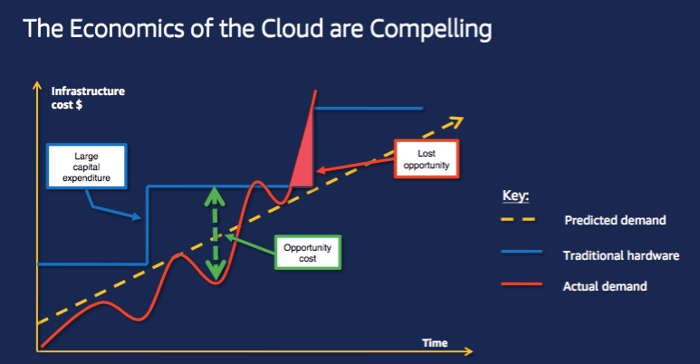
In a traditional data centre we would typically see a dev | test | prod | dr type approach to defining non-production (development and test) and production (prod and disaster recovery) environments. The infrastructure for these environments would be purchased at a high cost. Then it would often be written down, for example over a typical 3-5 year hardware refresh cycle. Guesses would be made to estimate capacity in advance of equipment purchase, and proof-of-concept work would typically occur just-in-time of purchase. Proof-of-concept in a hardware refresh cycle might trial and prove new application architectures at that time, perhaps not to be revisited until the next refresh.

Environments in AWS Cloud

Thank goodness we’re no longer confined to traditional data centres! With Amazon Web Services, you can create infrastructure and services without paying any upfront purchase costs. You pay for what you use, when you use it. What’s more (and even better), when you are finished you can destroy the infrastructure and services you provisioned and no further costs are incurred. (Note of course I’m not suggesting you destroy your production environments here, but highlighting the lifecycle capability of provisioning environments in cloud).

TRG Talk - Cloud - The Economics of Cloud Computing

Run a proof-of-concept whenever you want! Trial adoption of database-as-a-service like Amazon Relational Database Service (RDS) to reduce your database administration costs and improve service availablity! Introduce high-availability and self-healing compute infrastructure, with Amazon Elastic Load Balancing across Availability Zones and EC2 Auto Scaling!

Why Does It Matter?

Cloud providers such as Amazon Web Services have heralded changes that are nothing short of revolutionary. These changes contribute to the widely acknowledged current technological revolution – the Fourth Industrial Revolution. Globally we have seen the concept of cloud economics introduced to organisations and rapidly adopted. There’s now a more level playing field between smaller organisations and larger ones, which is accelerating innovation, disruptive ideas and products.

Underlying digital agility, innovation and productivity is IaC. Infrastructure-as-Code. IaC is a foundational capability of agile digital organisations. Using IaC you write the programming code to create your infrastructure and services. Once the code is written, the process is effectively automated.

Amazon Web Services provides CloudFormation and the Cloud Development Kit (CDK) for IaC.

Why use a human to do dumb, repetitive tasks? Automate them and boost your operational efficiency. Once you have your infrastructure code in hand, build a DevOps pipeline to manage the process of provisioning.

Foundational DevOps relies on IaC.

Amazon Virtual Private Cloud

Amazon Virtual Private Cloud (VPC) is an abstract network service that allows you to create a virtual network of your own. Back when first introduced in 2009, it was a revolutionary concept that enabled the creation of a network of your very own – without you needing to own any IT hardware.

IoT smart cities

At present time of writing a VPC enables you to create a network address space using any IPv4 address range, including RFC 1918 or publicly routable IP ranges. The network can be between 16 and 65,536 IPv4 addresses in size. IPv6 is also supported.

The architecture of AWS Global Infrastructure means that your VPC spans multiple Availability Zones. It spans all Availability Zones in the AWS Region. Unlike many technology infrastructure providers, every AWS Region has 3 or more Availability Zones (AZ). AZs are geographically separated locations within an AWS region, connected by redundant fast fibre-optic data links.

You can learn more about the AWS Global Network here: AWS re:Invent 2016: Amazon Global Network Overview with James Hamilton

Within your VPC, you define subnets in an Availability Zone. This means whilst your VPC spans all AZs, your subnets will not.

To manage and secure network traffic flow you use route tables. A VPC is created with a main route table. Each subnet you create must be associated with a custom route table or the main route table. The route table defines routing for your subnet, indicating how network data should flow.

To further secure your subnets, Network Access Control Lists (NACLs) can be defined. A NACL can be used to explicitly Allow or Deny network data to cross the boundary into or out of your subnet. Each subnet must be associated with a NACL – either the default NACL (provisioned when your VPC is first created) or a custom NACL.

One more security feature for capturing network traffic flows is VPC Flow Logs. This allows you to capture the traffic that flows to and from the network interfaces in your VPC or subnet.

There is much more to VPCs than this but these are the fundamentals. You can create an AWS account and create and destroy VPCs either through a management console or programmatically.

There is some further reading here exploring options to extend your data centres to include VPCs: AWS Whitepaper: Extend Your IT Infrastructure with Amazon Virtual Private Cloud

PrivateLink – It’s a Kind of Magic

AWS PrivateLink is an interesting way to create an endpoint by which you can provide services to other AWS accounts. You can do this without the need to run requests through the Internet and without peering or otherwise “connecting” VPCs. What is this particular type of AWS magic, I hear you say?

Says the Amazon web site, “AWS PrivateLink provides private connectivity between VPCs and services hosted on AWS or on-premises, securely on the Amazon network. By providing a private endpoint to access your services, AWS PrivateLink ensures your traffic is not exposed to the public internet. AWS PrivateLink makes it easy to connect services across different accounts and VPCs to significantly simplify your network architecture.”

So this is a particularly interesting AWS magic trick in that we can provide services to other consumer VPCs, through the Amazon backbone. We simply do two things to make his happen:

  1. Create an Endpoint Service, in our serivce provider VPC
  2. Create an Interface Endpoint (linked to our Endpoint Service), in our service consumer VPC

Where this gets really interesting is that it avoids all the unruliness of network address spaces and having to deal with Network Address Tranlsation (NAT). Routing works through a network interface to the endpoint service and you don’t have to worry about the network addresses. And if the endpoint service is unavailable in one Availability Zone, well that’s not a problem because your endpoint service will load balance across multiple Availability Zones.

Not to put too finer point on it, but to get the engineering and provisioning underlying all that without lifting a finger? That’s a kind of magic.

Going Mobile

It’s been a long time coming, but I have a feeling that the Cloud is about to get real. For everybody.

Google had a good offering for a while, and Adobe have a small corner of the market. But, Microsoft have been busy. They are on board, and they have turned a corner.

Microsoft Office 365 is now a fully-operational cloud offering. Office 365 works on all devices. For example, iPhone, Galaxy, Nexus, iPad, MacBook, Laptop etc.

What this means is that you can use Outlook, Word, Excel, PowerPoint. Anywhere, anytime on anything. Because not only do you get those applications… you also get a cloud file system, Sharepoint.

To be honest, I think this has the potential to create a step change in the way people work and live. That’s a bold statement but, frankly, all previous offerings pale in comparison to what Office 365 offers.