
From Reactive AI to Agentic Systems: The Rise of Goal-Driven Intelligence in the Cloud 

AI Was Never the End State 

For years, organisations have invested heavily in artificial intelligence, building capabilities around chatbots, predictive models, and recommendation engines that have steadily delivered value across different parts of the business. 

These systems have been effective, but only within clearly defined boundaries. They respond to inputs, analyse data, and automate tasks that have already been mapped out in advance. 

What they do not do is think ahead, plan independently, or act with intent beyond the instructions they are given. 

That distinction matters more now than it ever has, because the role of AI is starting to shift. 

The Limits of Reactive AI 

Most AI systems deployed today are still fundamentally reactive in nature. They rely on a simple cycle: wait for input, process the data, and return an output. 

This model works well in controlled environments and continues to support use cases such as customer support automation, forecasting, analytics, and content generation. 

However, as operating environments become more dynamic and interconnected, the limitations of this approach become increasingly visible. 

Reactive systems struggle to orchestrate multi-step processes, adapt strategies in real time, coordinate across multiple systems, or act without explicit prompts. These gaps are not due to a lack of intelligence, but rather a lack of agency. 

And that is where the real constraint lies. 

Enter Goal-Driven AI Agents 

Agentic AI introduces a fundamentally different operating model. Instead of waiting for instructions, systems are designed to operate against defined objectives and take the necessary steps to achieve them. 

This means they can break down goals into smaller tasks, determine which tools or data sources are required, execute actions across systems, and continuously evaluate outcomes to refine their behaviour. 

In practical terms, this could involve a system monitoring a supply chain and adjusting inventory levels before disruptions occur, or managing a marketing campaign that optimises itself across multiple channels without constant human input. 

It might also include identifying inefficiencies within internal systems and triggering optimisation workflows, or coordinating different tools to complete complex tasks from start to finish. 

The shift may appear subtle on the surface, but it represents a meaningful change in how systems operate. 

We are moving from a model that responds to instructions toward one that actively pursues outcomes. 

Why the Cloud Is Critical 

Agentic AI does not operate in isolation, and its effectiveness is closely tied to the capabilities of the cloud environments in which it runs. 

These systems depend on continuous access to data, scalable compute resources for reasoning and execution, seamless integration across APIs and enterprise platforms, and real-time feedback loops that allow them to adjust behaviour as conditions change. 

Without this underlying infrastructure, it becomes difficult to orchestrate workflows across systems, scale decision-making processes, or maintain the persistent context required for autonomous operation. 

This is where previous cloud investments begin to deliver compounding value. Cloud is no longer just the environment in which AI is hosted; it is the foundation that enables autonomous systems to function at scale. 

Frameworks Enabling Agentic AI 

The rise of agentic AI is being accelerated by a new generation of frameworks designed to support orchestration, memory, and multi-step execution. 

LangChain, for example, allows developers to connect language models with tools, memory, and workflows, enabling systems to maintain context across interactions and execute more structured processes. 

CrewAI extends this further by introducing multi-agent collaboration, where different agents take on specific roles and work together toward a shared objective, creating a system that begins to resemble a coordinated digital workforce. 

Emerging frameworks such as OpenClaw point toward a more flexible and open approach to agent orchestration, where organisations can design and customise how agents behave rather than relying solely on pre-defined capabilities. 

This reflects a broader shift in expectation. Organisations are no longer just looking for powerful models; they are looking for systems they can shape and control. 

What This Means for Business Operations 

The introduction of agentic AI is not simply an incremental improvement in efficiency. It represents a structural shift in how work is executed within organisations. 

The traditional model of humans interacting with tools to produce outputs is gradually being replaced by a model where humans define goals, and systems take on the responsibility of executing toward those outcomes. 

This has direct implications across multiple areas. 

Operationally, routine coordination tasks can become autonomous, allowing teams to focus more on direction and strategy. 

In decision-making, AI moves beyond providing insights and begins to act on them within defined parameters. 

From a productivity standpoint, the nature of work shifts from task execution to system oversight, while scalability improves as organisations can expand operations without a corresponding increase in headcount. 

At the same time, this shift introduces a new layer of complexity. 

The Governance Challenge 

As systems gain more autonomy, the importance of governance increases significantly. 

Organisations must define what decisions AI agents are allowed to make independently, establish clear boundaries, and ensure that actions can be audited and traced when needed. 

Questions around accountability also become more prominent, particularly in situations where systems are making decisions that have real operational or financial impact. 

Agentic systems have the potential to amplify both capability and risk. Without the right governance structures in place, increased autonomy can quickly translate into increased exposure. 

This is where architecture, policy, and cloud infrastructure need to work together as a cohesive system. 

Strategic Checkpoint 

For organisations exploring this space, it is worth taking a step back and assessing readiness from a broader perspective. 

Are your systems designed to execute, or are they still primarily focused on analysis? 

Can your infrastructure support continuous, autonomous workflows? 

Do you have governance models in place to manage AI-driven decision-making? 

And are you actively experimenting with agentic systems, or still relying solely on prompt-based interactions? 

These are not theoretical questions. They are practical considerations that will shape how effectively organisations can adapt to what is already unfolding. 

Final Thought 

AI is no longer just a tool that supports isolated tasks. It is becoming a system of action that influences how work is carried out across the organisation. 

The transition from reactive models to goal-driven agents marks a significant shift in how technology contributes to business outcomes. 

However, the real advantage will not come from adopting these systems alone. It will come from designing the environments in which they operate, ensuring that they are secure, governed, and aligned with organisational objectives. 

Because ultimately, the value of AI will not be measured by what it can say. 

It will be measured by what it can do. 

Resources 


All views are my own personal opinions.


Stay informed on the evolving intersection of cloud, AI, and digital transformation.

Subscribe to the newsletter for monthly insights, strategic analysis, and emerging trends shaping enterprise and government technology.


Trends and Innovations in Cloud and AI | 2026 Outlook for Australian Government and Enterprise

What Cloud Was vs. What It Must Become 

Ten years ago, moving to the cloud was a practical decision, reducing costs, increasing flexibility, and getting out of the data center business. But that was then. In 2026, the cloud isn’t just an infrastructure choice; it’s the bedrock of intelligence, automation, and digital resilience. 

Today, your cloud strategy is your AI strategy. 

And here’s the catch: it’s not enough to migrate. It’s about how you build in the cloud, how you design performance, interoperability, and continuous evolution. 

This post breaks down the most important cloud and AI trends impacting Australian enterprise and government, from edge and GenAI, to workforce strategy and resilience engineering. Let’s get into it. 

Why Cloud-First Now Means AI-First 

We’ve outgrown the idea of cloud as just storage and compute. Today, it’s the execution layer for intelligence. 

Without an AI-ready cloud, you can’t scale generative tools, secure real-time data flows, or deploy intelligent automation. These demands call for a modern stack with GPU-backed clusters, container-native architectures, and low-latency access, by default. 

Australian organizations, from healthcare and universities to finance and public services; are deploying AI at scale. But only those who design their cloud to support AI model training, inference, and continuous governance will keep up. 

The shift is clear: cloud-first is now capability-first. If your stack can’t support streaming data, AI pipelines, or compliance automation, you’re not ready for what’s next. 

Edge Computing: Intelligence Where It’s Needed 

From regional hospitals to smart transport systems, Australia’s public-facing services are transforming into distributed, intelligent networks. 

Edge computing moves the action closer to where data is generated, whether it’s a mobile health unit, traffic signal, or emergency responder. This means faster decisions, reduced latency, and critical bandwidth savings. 

Especially in regulated sectors like defense, health, and energy, edge computing isn’t optional. It’s the new standard for sovereignty, uptime, and safety. 

Containerization: Portable, Consistent, and Scalable 

As workloads move across on-prem, hybrid, and multi-cloud environments, containers are the glue that holds it all together. 

With tools like Kubernetes and OpenShift, teams can develop once and deploy anywhere—with consistency and speed. 

Benefits include: 

  • Seamless portability across environments 
  • Rollback-ready version control 
  • Policy-based compliance at deploy-time 
  • Faster iteration and testing 

For ageing government systems, containerization offers a practical path to modernization; without overhauling the entire tech stack. 

AIOps: Letting Machines Manage Machines 

Cloud infrastructure is complex. Monitoring it manually? Not scalable. 

That’s where AIOps come in, using machine learning to manage and maintain your digital backbone. 

Whether it’s alert prioritization, root cause analysis, or self-healing, AIOps makes it possible to run large, distributed systems with smaller teams. 

For resource-constrained public IT departments, this isn’t just efficient. It’s survival. 

Generative AI: From Pilots to Platforms 

2024 was the year for GenAI pilots. 2025 brought governance frameworks. And now, in 2026, we’re seeing GenAI in production. 

Australian agencies are applying GenAI to: 

  • Case management and knowledge retrieval 
  • Legal interpretation and policy support 
  • Content creation for multilingual, accessible public communications 
  • Citizen-facing chat and service automation 

But to scale GenAI, the foundations must evolve: 
You need data access strategies, security controls, audit trails, and governance workflows. Otherwise, your pilot will never reach platform status. 

Workforce Capability: The X-Factor 

Even with the best tech stack, transformation is human. 

Australia faces a widening gap in cloud and AI expertise. The solution isn’t always hiring; it’s to build from within. 

That means: 

  • Upskilling internal teams on cloud-native dev, GenAI, and cyber frameworks 
  • Establishing communities of practice to scale new ideas 
  • Embedding learning directly into digital transformation plans 

The most innovative orgs in 2026 will be the ones who prioritized talent alongside tech. 

Resilience Must Be Engineered, Not Assumed 

We’ve moved past the point where resilience is a checkbox. In today’s world of hyperconnected systems, resilience must be designed. 

That includes: 

  • Multi-region cloud architectures 
  • Redundant data flows and failover systems 
  • AI-driven anomaly detection 
  • Autonomous recovery and fail-safe protocols 

For citizen-facing platforms, this isn’t just uptime. It’s about preserving public trust. 

Final Thought: From Disruption to Integration 

Cloud and AI aren’t here to disrupt anymore. They’re here to integrate; into how we deliver services, build trust, and respond to a changing world. 

The leading organizations in 2026 won’t be the flashiest. They’ll be the most adaptable, those who’ve embedded intelligence, resilience, and ethics into how they operate. 

Whether you’re redesigning digital services or safeguarding national infrastructure, the future demands smart foundations. 

Let’s build those foundations now. Let’s build wisely. 

Resources 

Public Sector Cloud Strategy and Transformation in Australia

Are Australian governments unlocking the full cloud promise; or just testing the waters? 

Australia’s public sector has embraced cloud as a strategic enabler, not just an IT upgrade. But with rising expectations for secure, citizen-centric digital services, agencies now face a tougher challenge: moving from cloud adoption to cloud maturity

The ambition is high. The complexity is real. And the decisions government leaders make now will shape the next decade of public sector capability. 

Embedding Hybrid & Public Cloud into the National Digital Government Visio

Australia’s Data and Digital Government Strategy (2023) and the forthcoming Whole-of-Government Cloud Computing Policy (effective July 2026) mark a pivotal shift: cloud-first is no longer aspirational. It’s the default operating model for modern government. 

This isn’t just a technology upgrade. It’s a structural change in how the government delivers services, manages risk, and builds resilience. 

These frameworks push agencies to: 

  • Use public cloud for new digital services 
  • Actively retire legacy and high-risk systems 
  • Prioritise reusable, interoperable platforms 
  • Modernize procurement and governance 
  • Strengthen whole-of-government consistency 

In short, we’re moving from siloed ICT to shared national digital infrastructure, a foundation that supports collaboration, agility, and citizen trust. 

Hybrid cloud plays a critical role in this vision. Public cloud accelerates innovation and scalability, but hybrid architectures allow agencies to keep sovereignty over sensitive workloads while still gaining flexibility and cost efficiency. It’s not about choosing one or the other. It’s about designing a model that balances speed with control. 

This shift raises a leadership question: 
Does your Digital Investment Plan treat cloud as infrastructure or as a strategic capability that shapes service delivery? 

Secure Cloud Strategy: Building Resilience, Assurance & Agility 

The Secure Cloud Strategy, supported by ASD’s Blueprint for Secure Cloud, is designed to move the public sector away from “lift and shift” thinking toward secure design. 

This isn’t just a checklist for compliance. It’s a mindset shift. From treating cloud as a convenient hosting option to recognizing it as part of Australia’s critical national infrastructure. 

The strategy provides practical tools: 

  • Architecture patterns for secure deployment 
  • Risk assessment templates 
  • Guidance for configuration and hardening 
  • Clear shared responsibility boundaries 
  • Controls aligned to the PSPF and Essential Eight 

But the real goal is bigger … modernizing how government builds, tests, and operates services in an environment where threats are constant, and citizen expectations are uncompromising. 

A secure cloud strategy must help agencies: 

  • Detect threats faster 
  • Mitigate failures gracefully 
  • Respond to crises without downtime 
  • Maintain high trust in public digital services 

Cloud is no longer just a place to store applications. It’s the backbone of the digital government. Every outage, every breach, every delay impacts public confidence. Treating cloud as critical infrastructure means designing resilience, agility, and assurance from day one. 


Is your cloud security posture reactive or embedded as a strategic capability that protects trust and continuity? 

Navigating Sovereignty, Security & Complexity 

Australia’s cloud environment isn’t just shaped by technology choices, it’s defined by regulatory guardrails, security expectations, and sovereignty obligations that few other markets face. For public sector leaders, these aren’t optional considerations. They’re foundational to trust and compliance. 

Data Sovereignty: More Than a Location Requirement 

Under the PSPF, Privacy Act, and sector-specific rules like the My Health Records Act and APRA CPS 234, agencies must ensure sensitive data: 

  • Stays within Australian jurisdiction 
  • Is processed by vetted and accredited providers 
  • Aligns with sovereign risk and resilience standards 

This is why sovereign cloud regions, such as those in Canberra and Sydney, matter. They’re not just technical zones. They’re protected environments for workloads with national sensitivity, ensuring that critical data remains under Australian control. 

Across Australia’s cloud policy, protective security framework, and secure cloud guidance, the message is consistent: sovereignty is a foundation for resilience. Control over data, jurisdiction, and access is not about geography alone; it is about reducing national risk, strengthening security posture, and ensuring continuity in the face of disruption. 
Read more here. 

Security Expectations: Continuous, Not Occasional 

Australia’s Essential Eight maturity model, ISM controls, and PSPF frameworks demand more than periodic audits. They require ongoing posture management, because in a cloud world, risk is dynamic. 

That means: 

  • Continuous monitoring 
  • Policy automation 
  • Zero Trust architecture 
  • Governance at scale 

Security isn’t a bolt-on. It’s a living capability that evolves as threats evolve. 

Operational Complexity: The Hidden Challenge 

Cloud promises simplicity, but reality often looks different. Agencies face: 

  • Multi-cloud governance friction 
  • Cost unpredictability 
  • Talent shortages for cloud-native skills 
  • Risk of over-dependence on a single vendor 

Recent ANAO audits show that failures rarely stem from cloud itself. They come from governance, maturity, and lagging adoption. Technology moves fast. Policy and capability must be kept at a pace. 

 
Is your agency treating sovereignty, security, and complexity as compliance hurdles or as strategic levers for trust and resilience? 

Sharpening Cloud ROI & Agility: CIO Best Practices 

Cloud maturity isn’t measured by how many systems an agency migrates. It’s measured by how effectively cloud supports outcomes, resilience, cost efficiency, service improvement, and risk reduction. The question isn’t “How much cloud do we have?” but “How much value does it deliver?” 

High-performing CIOs in the public sector share a common approach. They treat cloud as a strategic capability, not just infrastructure. Here’s what sets them apart: 

1. Strategic Governance Built-In 

Cloud strategy must be embedded early in Digital Investment Plans, not bolted on later. Governance isn’t paperwork. It’s the guardrails that keep transformation on track. 

What does this look like? 

  • Portability clauses to avoid lock-in 
  • Vendor-neutral patterns for flexibility 
  • Reusable reference architectures 
  • Clear multi-cloud guardrails 

This ensures consistency across agencies and reduces reinvention. It’s about building a system that scales without chaos. 

2. Cost Transparency & Control (FinOps for Government) 

Cloud can be a silent cost escalator if left unchecked. That’s why the government is adopting FinOps disciplines, blending finance and operations to make spending visible and accountable. 

Key practices include: 

  • Real-time monitoring across providers 
  • Workload right-sizing 
  • Clear unit costing 
  • Independent audits of cloud use 

The goal? Every dollar spent on cloud should map to measurable public value. 
Read the FinOps Public Sector Whitepaper. 

3. Agile, Risk-Aware Security Models 

ASD’s blueprint stresses continuous, adaptive security. CIOs must: 

  • Align provider responsibilities 
  • Automate compliance checks 
  • Standardize configurations across environments 

Security isn’t a static policy. It’s a living system that evolves as threats evolve. 

4. Effective Hybrid Architecture 

Sensitive workloads often remain in sovereign regions or protected private environments, while scalable digital services leverage public cloud elasticity. The challenge? Integration. 

Legacy systems and modern cloud-native platforms must interoperate seamlessly, securely, reliably, and under consistent governance. This is where architecture discipline meets operational reality. 

5. Culture, Skills & Centers of Excellence 

Technology transformation fails without workforce capability. Agencies benefit from creating: 

  • Cloud Centers of Excellence (CCoE) 
  • Cloud-native training pathways 
  • Shared learning across government 
  • Communities of practice 

This builds consistent standards and accelerates adoption. Cloud isn’t just a tech shift. It’s a cultural one. 

6. Measuring Business Outcomes 

CIOs are moving beyond technical KPIs to outcome-based metrics: 

  • Reduced operating risk 
  • Improved citizen experience 
  • Strengthened service resilience 
  • Shorter delivery cycles 
  • Lower cost-to-serve 

Cloud success is strategic, not technical. It’s about impact, not infrastructure. 

 
Is your cloud program measured by migration milestones, or by the outcomes that matter most to citizens and government resilience? 

Looking Ahead: The Cloud-Enabled Public Sector 

Australia is building a public sector cloud ecosystem that balances innovation with sovereignty, resilience, and trust. 

The next step is consolidation. Not just running hybrid environments, but aligning them into a cohesive, cloud-native platform for the entire public sector. 

The real test: 
Can agencies deliver unified, citizen-first public services while managing risk, cost, and national control? 

 
What would success look like for your agency’s cloud-first journey in 2026 and beyond? 

Resources 

• Data and Digital Government Strategy (DTA) 

https://www.dta.gov.au/our-initiatives/data-and-digital-government-strategy

• Whole-of-Government Cloud Computing Policy 

https://www.digital.gov.au/cloud-policy

• Secure Cloud Strategy 

https://architecture.digital.gov.au/strategy/secure-cloud-strategy

• ASD Blueprint for Secure Cloud 

https://blueprint.asd.gov.au/

• Cyber.gov.au – Cloud Computing Guidance 

https://www.cyber.gov.au/business-government/protecting-devices-systems/cloud-computing

• Protective Security Policy Framework (PSPF) 

https://www.protectivesecurity.gov.au/

• Privacy Act 1988 

https://www.oaic.gov.au/privacy/privacy-legislation/the-privacy-act

• Digital Investment Management Framework (DIMF) 

https://www.dta.gov.au/our-initiatives/digital-investment-management

• Australian Government Architecture – Cloud and Hosting 

https://architecture.digital.gov.au/domains/cloud-and-hosting

• ASD Essential Eight 

https://www.cyber.gov.au/resources-business-and-government/essential-cyber-security/essential-eight

• ANAO Reports and Audit Insights 

https://www.anao.gov.au/

• FinOps Framework (FinOps Foundation) 

https://www.finops.org/framework/

Foundational DevOps

Benefits of Infrastructure-as-Code and Cloud Economics

As I see customers adopt Amazon Web Services, one of the first benefits they quickly realise is the ability to create and bootstrap environments at a time that suits them. This is a great benefit that helps to: (1) manage costs; and, (2)  enable experimentation of new ideas. It appeals from both a financial perspective and an engineering perspective. With this foundational capability in hand, an organisation can build on it to gain further benefits. For example, accelerating product development to gain a competitive advantage.

Environments in Traditional Data Centres

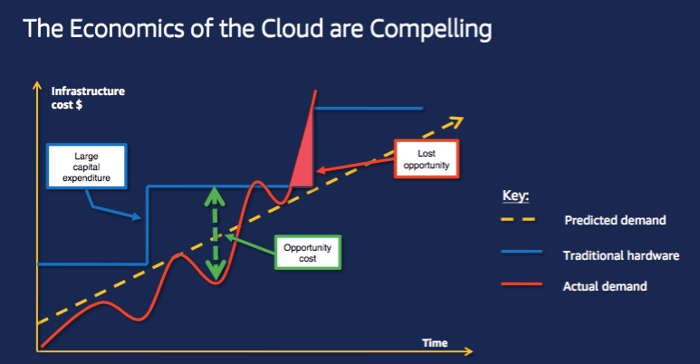
In a traditional data centre we would typically see a dev | test | prod | dr type approach to defining non-production (development and test) and production (prod and disaster recovery) environments. The infrastructure for these environments would be purchased at a high cost. Then it would often be written down, for example over a typical 3-5 year hardware refresh cycle. Guesses would be made to estimate capacity in advance of equipment purchase, and proof-of-concept work would typically occur just-in-time of purchase. Proof-of-concept in a hardware refresh cycle might trial and prove new application architectures at that time, perhaps not to be revisited until the next refresh.

Environments in AWS Cloud

Thank goodness we’re no longer confined to traditional data centres! With Amazon Web Services, you can create infrastructure and services without paying any upfront purchase costs. You pay for what you use, when you use it. What’s more (and even better), when you are finished you can destroy the infrastructure and services you provisioned and no further costs are incurred. (Note of course I’m not suggesting you destroy your production environments here, but highlighting the lifecycle capability of provisioning environments in cloud).

TRG Talk - Cloud - The Economics of Cloud Computing

Run a proof-of-concept whenever you want! Trial adoption of database-as-a-service like Amazon Relational Database Service (RDS) to reduce your database administration costs and improve service availablity! Introduce high-availability and self-healing compute infrastructure, with Amazon Elastic Load Balancing across Availability Zones and EC2 Auto Scaling!

Why Does It Matter?

Cloud providers such as Amazon Web Services have heralded changes that are nothing short of revolutionary. These changes contribute to the widely acknowledged current technological revolution – the Fourth Industrial Revolution. Globally we have seen the concept of cloud economics introduced to organisations and rapidly adopted. There’s now a more level playing field between smaller organisations and larger ones, which is accelerating innovation, disruptive ideas and products.

Underlying digital agility, innovation and productivity is IaC. Infrastructure-as-Code. IaC is a foundational capability of agile digital organisations. Using IaC you write the programming code to create your infrastructure and services. Once the code is written, the process is effectively automated.

Amazon Web Services provides CloudFormation and the Cloud Development Kit (CDK) for IaC.

Why use a human to do dumb, repetitive tasks? Automate them and boost your operational efficiency. Once you have your infrastructure code in hand, build a DevOps pipeline to manage the process of provisioning.

Foundational DevOps relies on IaC.